

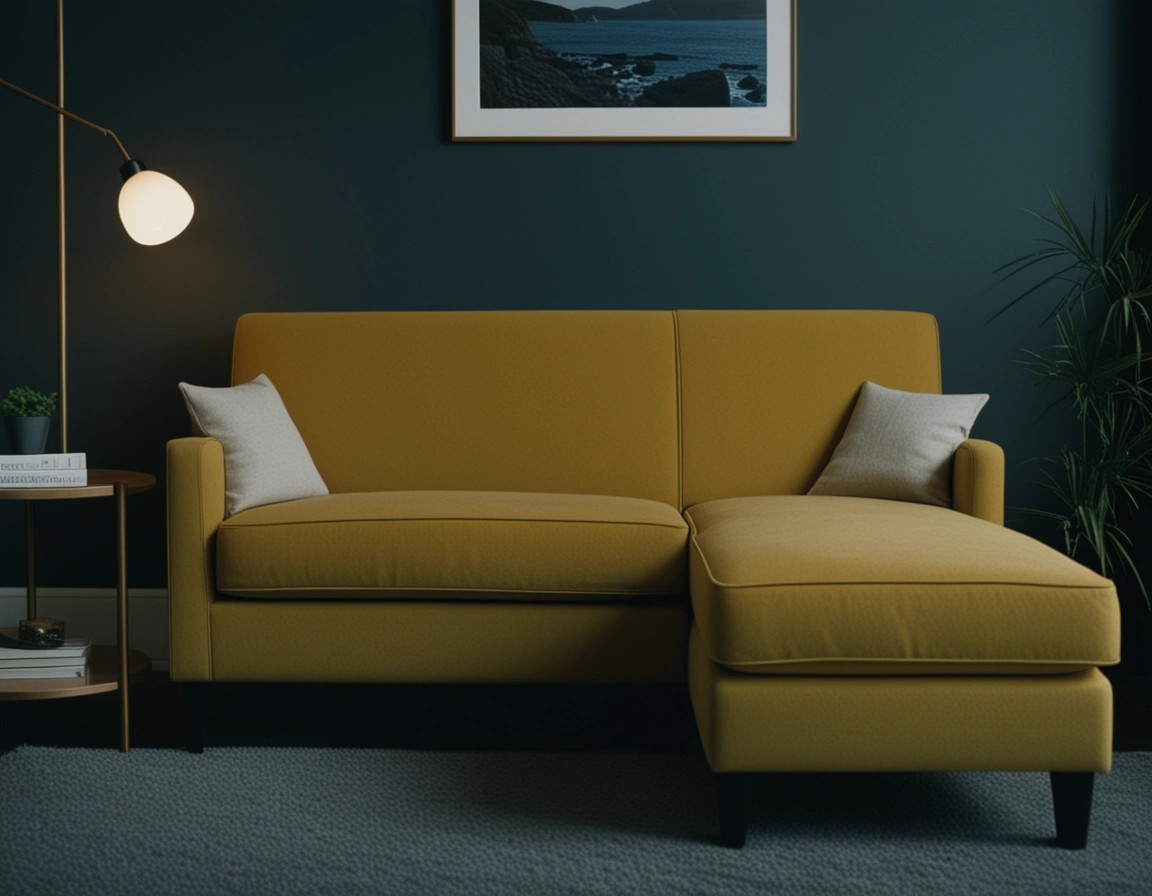
Buying a chaise longue sofa isn’t like buying a regular couch. You’re adding a piece of furniture that eats up floor space, defines how you actually use your living room, and either becomes the spot everyone fights over or the awkward thing you trip on every morning. Here’s how to get it right the first time.
Measure Twice, Because a Chaise Longue Sofa Doesn’t Shrink
Before you fall in love with anything online, grab a tape measure and map the footprint on your floor with masking tape. A chaise longue sofa typically runs between 80 and 110 inches long, and the chaise section alone can extend 60 to 70 inches from the backrest.
That’s a lot of real estate. The mistake most people make is measuring only the wall where the sofa will sit. You also need to know how much walking space stays clear between the chaise and your coffee table, TV unit, or doorways. Aim for at least 18 inches of clearance on the open side.
If your living room is under 150 square feet, a left-arm or right-arm chaise sofa will feel cramped. In that case, look at a compact two-seater with a small chaise, or reconsider whether a standard three-seater with an ottoman gives you the same lounging flexibility without locking you into one layout.
Left-Arm, Right-Arm, or Reversible? Get This Wrong and You’ll Regret It
This is the detail that trips up almost every buyer. A left-arm chaise longue sofa has the extended seat on the left when you’re facing the sofa. Sounds obvious until you’re standing in a showroom trying to visualize your own living room from the opposite angle.
Think about where the chaise will point. If it backs onto a window or a wall, you want the chaise extending into the room, not jammed against a radiator. If your sofa sits in an open-plan space, a reversible chaise longue sofa is the smarter call because you can flip the configuration later if you rearrange the room.
My honest take: unless you have a fixed layout you’ll never change, pay the extra for reversible. It’s the single feature that saves you from selling a six-month-old sofa on Marketplace at half price.
Fabric Choice: Match It to Your Actual Life, Not Your Pinterest Board
Nobody wants to hear this, but a cream linen chaise longue sofa is a terrible idea if you have a Labrador and a toddler. The material you pick decides how the next five years of your life go.
- Microfiber and performance weaves: Best all-rounder for families. Stain-resistant, holds up to daily abuse, and doesn’t pill as fast as cheap polyester.
- Treated leather: Wipes clean in seconds, ages with character, but cold in winter and can crack if you skip conditioning.
- Bouclé and chenille: Gorgeous and trendy in 2026, but they snag on everything and trap pet hair like a magnet.
- Velvet: Luxurious, but shows every crumb and crush mark. Only if your living room is a low-traffic zone.
Ask for a fabric swatch and rub it with a wet cloth and a bit of coffee. If it stains on the spot, it’ll stain in your home. Any decent retailer will let you do this.
Sit on It for at Least 15 Minutes Before You Commit
Comfort on a chaise longue sofa comes down to two things: cushion density and frame quality. A sofa that feels amazing for 30 seconds can feel like a brick after an hour of Netflix.
Press down hard on the seat cushion. It should push back slowly, not collapse or feel like a slab of foam. High-resilience foam (often labeled HR foam) with a density around 2.5 lb/ft³ is the sweet spot for a chaise that gets daily use.
Check the frame too. Kiln-dried hardwood — beech, oak, or birch — will outlast particle board by a decade or more. If the showroom staff can’t tell you what the frame is made from, walk away. That’s a red flag, not a minor detail.
If the chaise section sags after six months, it’s almost never the fabric’s fault. It’s cheap foam and a softwood frame doing exactly what you’d expect.
Extra Features That Are Actually Worth Paying For
A chaise longue sofa with reclining seats sounds great until you realize the mechanism adds bulk and, in cheaper models, breaks within two years. Prioritize features that solve real problems.
- Integrated storage under the chaise is genuinely useful if you live in an apartment — it swallows blankets, remotes, and kids’ toys.
- Modular configurations matter if you might move or want to split the sofa later.
- A power outlet or USB port built into the armrest is a nice touch if you work from the couch.
What’s not worth it: massage functions, built-in speakers, and LED lighting strips. They inflate the price, add electronics that fail, and make the sofa look dated fast.
Match the Sofa to Your Room, Not the Other Way Around
A chaise longue sofa anchors the whole living room, so it has to speak the same visual language as everything else. In a modern minimalist space, go low-profile with clean lines and a slim metal or wooden leg. In a classic or transitional room, rolled arms and tufted backs still work, but skip the heavy skirted base — it visually shrinks the room.
Color-wise, a neutral base (greige, charcoal, deep navy, or warm taupe) gives you the most flexibility if you like changing cushions and throws. That said, a deep green or rust chaise longue sofa in a room with white walls and wooden floors looks intentional and much more expensive than it is.
The one rule that always works: your sofa should be the largest piece in the room, and its color should repeat somewhere else — a rug, artwork, or curtains. Otherwise it floats and looks like an afterthought.
Budget Reality Check
You can find a chaise longue sofa under $500, but expect a particle-board frame, low-density foam, and fabric that pills in a year. Between $900 and $1,800 is where you get real hardwood frames, decent foam, and stain-resistant upholstery. Above $2,500 you’re paying for design, brand, or genuine leather — sometimes worth it, often not.
Spend your money on the frame and the foam first, the fabric second, and the brand last. That’s the order that determines whether you’re still happy with the sofa in 2032.