

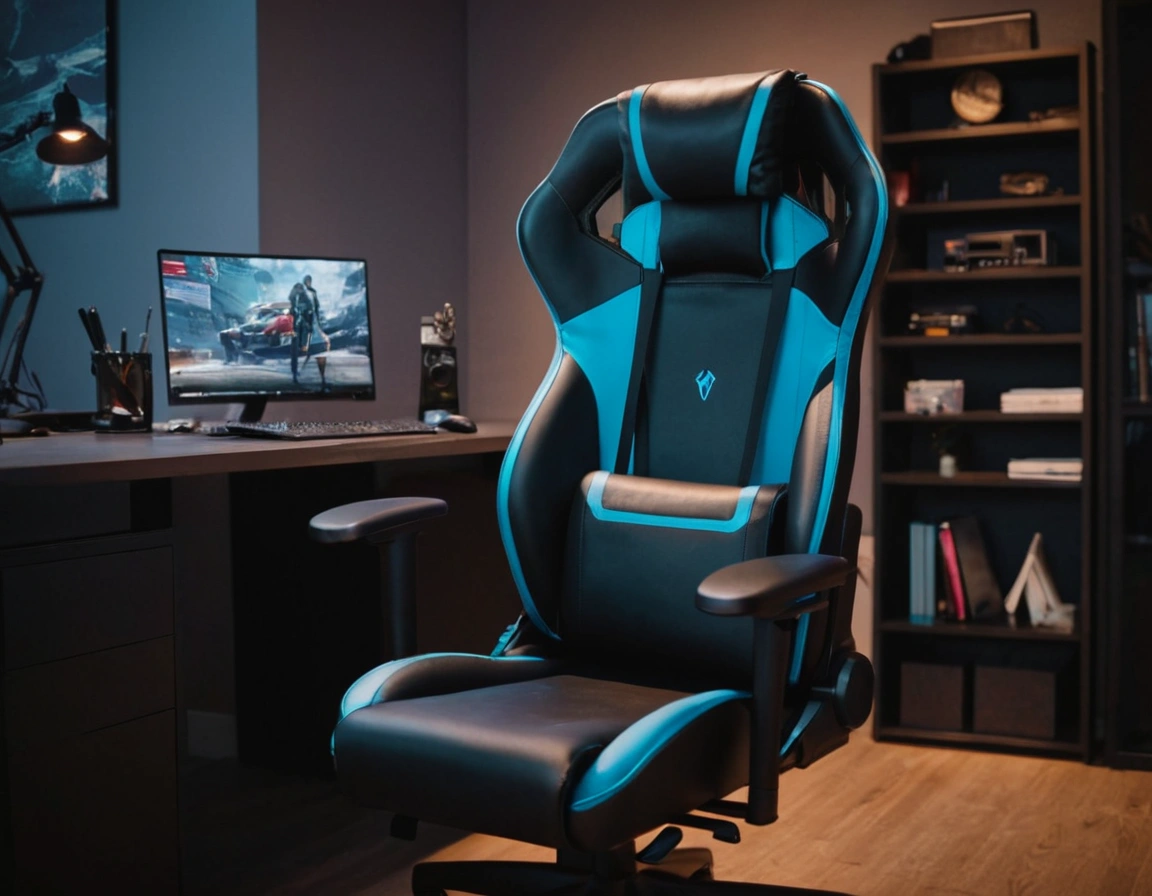
If you’re actually planted in a chair for 8, 10, or 12 hours a day, the marketing language around “gaming chairs” starts to fall apart fast. Most of them are built for a 2-hour stream, not for a full workday followed by a raid. I dug through ergonomics research, real owner complaints on Reddit and Trustpilot, and spec sheets from brands like Herman Miller, Secretlab, Steelcase, and Sihoo to figure out what actually matters when you clock serious hours. Here’s the honest breakdown.
Why ergonomic support is non-negotiable past the 8-hour mark
Ergonomics isn’t a buzzword — it’s the difference between finishing the day fine and finishing it with a knot between your shoulder blades. An ergonomic gaming chair for long sessions needs adjustable lumbar support that hits the curve of your lower back, not some pillow strapped on as an afterthought.
Look for lumbar that moves up and down at minimum. If it also adjusts in depth, even better — that’s what keeps your spine in a neutral S-curve instead of a C-shape after hour six. Cervical support matters too, but only if the headrest actually reaches your neck, not the back of your skull.
OSHA and most ergonomics guidelines point to the same thing: your feet flat, knees at roughly 90°, elbows at 90°, screen at eye level. A chair that can’t help you hit those angles is just a throne with a logo.
Padding: firm beats soft every single time
Here’s a hill I’ll die on: soft, pillowy padding is a trap. Memory foam that feels amazing in the store collapses under your sit bones after three hours and leaves you squirming. What you want is high-density cold-cure foam — usually 50–60 kg/m³ density — which feels firm at first and stays supportive all day.
Breathability is the other half of this. PU leather looks great in photos and turns into a sauna by hour four. Mesh backs, or at least breathable fabric on the seat, keep your back from getting sweaty and sticking to the chair. If you live somewhere humid, mesh isn’t a preference — it’s a requirement.
Adjustability: the features that actually earn their price
Forget RGB and racing stripes. These are the adjustments that matter for a gaming chair for working and gaming:
- 4D armrests — up/down, forward/back, in/out, and pivot. Your elbows should rest at 90° with shoulders relaxed. 2D armrests are basically decorative.
- Seat height range — you need at least 10 cm of travel so your feet actually touch the floor without a footrest.
- Recline with lock positions — 90° for focused work, 110–120° for reading or casual play, 135°+ for breaks. Any chair that only reclines fully back is useless for real work.
- Seat depth — you want 2–3 fingers of gap between the back of your knee and the seat edge. Too deep and it cuts off circulation; too shallow and your thighs hang.
If a chair doesn’t offer most of that, it’s not an 8-hour chair. It’s a prop.
Durability: the spec sheets lie, the warranty doesn’t
A chair rated for 8+ hours of daily use has to survive years of it. Check the gas lift class — Class 4 is the standard for heavy use, Class 3 is fine for lighter bodies. Look at the base: nylon is common, aluminum is better, and steel is heaviest but nearly indestructible.
The real tell is the warranty. Brands like Herman Miller offer 12 years, Steelcase up to 12 on many models, and Secretlab does 5. If a company only backs its chair for one year, they’re telling you exactly how long they expect it to last. Believe them.
Weight capacity and body fit nobody talks about
Most gaming chairs are designed around a 170–185 cm, 70–90 kg frame. If you’re taller, shorter, or heavier, the “one-size-fits-all” claim is nonsense. A chair for prolonged gaming use should list its weight capacity clearly — 120 kg minimum for average adults, 150 kg+ if you’re on the bigger side.
Tall users should also check backrest height. Under 80 cm and your shoulders will hang off the top. Short users need a seat depth that doesn’t push them forward. This is why buying blind online is risky — measure your current chair, note what hurts, and use those numbers as your filter.
Fabric vs leather vs mesh: pick your poison
There’s no perfect material, only trade-offs. Leather (real or PU) is easy to clean but hot and eventually peels. Fabric breathes but stains. Mesh is the coolest and most breathable but can feel less plush and isn’t great if you have pets that shed.
For 8+ hours, I’d lean mesh back + fabric or hybrid seat every time. It’s not glamorous, but your skin will thank you and you won’t be peeling your thighs off the seat in July.
The 2026 reality check: don’t buy on looks
The gaming chair market in 2026 is flooded with sub-$200 lookalikes that use the same frame, same foam, and same 1-year warranty. They photograph well. They don’t hold up. If your budget is tight, a used Steelcase Leap or Herman Miller Aeron from a refurbisher will destroy any new $250 “racing style” chair for long-session comfort.
If you want new and gaming-flavored, expect to spend $400–$700 for something that actually respects your spine. Below that, you’re paying for aesthetics, not ergonomics.
Bottom line: search for adjustable lumbar, firm high-density foam, 4D armrests, real recline locks, Class 4 gas lift, and a warranty that proves the brand believes in its own product. Everything else — the carbon fiber trim, the LED strips, the “pro gamer approved” badge — is noise. Your back after a 10-hour session will tell you the truth, and it doesn’t care how cool the chair looked in the ad.