
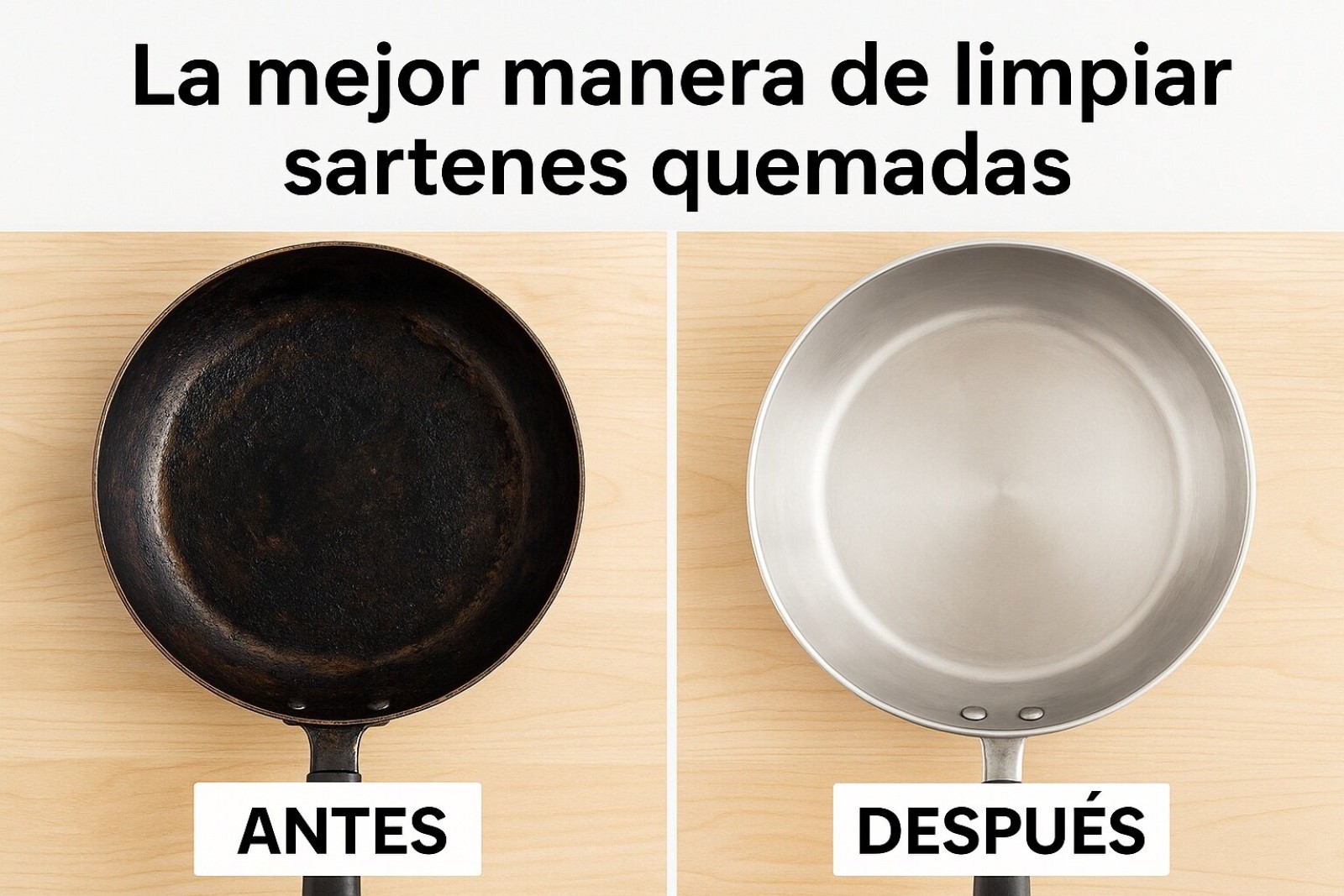
Seeing a burnt frying pan can be discouraging, especially when you don’t know where to start. Many people think it’s ruined and that their only option is to throw it in the trash. However, in the vast information available on the internet, you constantly find testimonials and guides from people who have managed to restore their frying pans, even after the most serious kitchen accidents. This article compiles some of those methods, explaining why they work and how to apply them safely, without damaging the utensil any further.
The key is not to use brute force, but to understand the basic chemistry behind baked-on grime. Carbonized residues are basically a layer of carbon that has strongly adhered to the surface. To remove it, we need to soften and loosen that layer, and for that there are techniques ranging from natural solutions to specific products, always depending on the material of your frying pan.
The best way to clean burnt frying pans without damaging them
One of the first pieces of advice repeated in cooking forums is to act calmly and avoid abrasive methods immediately. Scraping with knives or using steel scouring pads can permanently scratch the surface, especially in the case of non-stick frying pans, causing them to lose their main property and deteriorate faster.
A method frequently cited by users on social media involves using heat and water to create loosening through expansion. The process consists of filling the frying pan with a little water and bringing it to a boil. When boiling, the steam and hot water help soften and lift the burnt residues. After a few minutes of boiling, it is removed from the heat and left to rest until it is lukewarm. Many report that, after this step, a large part of the residues comes off by simply using a wooden or silicone spatula.
For the most persistent remains, the general recommendation found is to create a paste with basic ingredients. Baking soda is mixed with a little water until a pasty consistency forms. This paste is spread over the burnt surface and left to act for several hours, or even overnight. Baking soda is a gentle abrasive and helps loosen the grime without scratching. The next day, it is scrubbed with a soft sponge and rinsed.
It is crucial to remember that, depending on the material, some methods are more suitable than others. What works for cast iron might not be ideal for a delicate non-stick surface. That is why it is always advisable to check the manufacturer’s instructions, which are usually available online, before trying any aggressive cleaning technique.
How to remove burns on frying pans with everyday products
It is surprising how solutions for complex problems can be found in the kitchen pantry. For those burns on frying pans that seem impossible, there is a very popular trick that uses only two ingredients: white vinegar and baking soda. The process begins by pouring a cup of white vinegar into the frying pan, along with two or three tablespoons of baking soda. The effervescent reaction that occurs helps loosen the carbonized food particles.
The mixture is allowed to bubble and act for at least 15 minutes. Then, the frying pan can be gently heated to enhance the effect. After turning off the heat and letting it cool a little, it is scrubbed with a non-abrasive scouring pad. Users in video blogs demonstrate that, often, the residues come off easily, leaving the frying pan noticeably cleaner.
Another highly effective everyday product is salt. Coarse salt acts as a natural, gentle abrasive. A generous layer of salt is sprinkled on the bottom of the still-hot (but not burning) frying pan and scrubbed with a kitchen cloth or folded paper towel. The salt helps polish the surface and drag away the grease and burnt remains. Finally, it is rinsed well with hot water.
Lemon is also a great ally. Its acidity helps cut through grease. Water can be boiled in the burnt frying pan with the juice of one or two lemons. It is left to boil for about ten minutes, removed from the heat, and left to soak until it cools. The combination of heat and acidity breaks down the residues, making subsequent cleaning easier by simply passing a sponge over it.
Effective techniques for stainless steel frying pans
Stainless steel frying pans are known for their durability, but they are not immune to burns. The advantage is that, since they do not have a delicate non-stick coating, they allow for more robust cleaning methods. A highly recommended method in specialized guides is descaling by boiling. The frying pan is filled with water, a generous amount of dish soap is added, and it is brought to a boil for several minutes. This helps the carbonized grease come loose.
For more difficult cases, what some call a “vinegar cleaner” can be created. One part white vinegar to one part water is mixed in the frying pan and brought to a boil. It is left to simmer over low heat for 10 minutes. The acetic acid in the vinegar breaks down mineral deposits and softens food residues. After letting it rest, it is scrubbed with a nylon-bristle brush.
If the residues persist, a specific stainless steel cleaner can be used. These products are formulated to remove burn stains without damaging the metal. It is important to apply them according to the package instructions and always wear gloves to protect the skin. After application, it is rinsed abundantly with water.
A last resort for the most stubborn stains on stainless steel is a paste of borax and water. Although it is a less common product today, some online tutorials still recommend it for scrubbing the affected areas with a soft brush, followed by a thorough rinse and immediate drying to prevent water spots.
Specific care for cast iron frying pans
Cast iron frying pans are almost eternal if cared for properly. A common mistake when dealing with a burn is washing it with aggressive soap, which can damage the seasoning layer. The “seasoning” is a layer of polymerized fat that protects the iron from oxidation and gives it its non-stick properties. Therefore, cleaning must be careful.
The most classic and widely documented method is cleaning with salt. The bottom of the frying pan is covered with coarse salt and a little hot water is added to form an abrasive paste. With a chainmail scrubber or a stiff-bristle brush, the surface is scrubbed vigorously. The salt removes the residues without damaging the “seasoning.” Then, it is rinsed with hot water only.
If the layer of residue is very thick, you can resort to boiling water in the frying pan. Sometimes, a little vinegar is added to the water to help loosen the most difficult pieces. After boiling and letting it rest, you proceed to scrub with salt as described above. It is essential to dry the frying pan immediately after rinsing to prevent rust.
A non-negotiable step after cleaning a cast iron frying pan is re-seasoning it. After drying it perfectly, it is heated slightly on the stove and a very thin layer of oil (such as canola or sunflower) is spread over its entire interior, including the sides. It is heated until it smokes slightly and then left to cool. This process maintains the “seasoning” and protects the frying pan for its next use.
What to do and what not to do with non-stick frying pans
Non-stick frying pans are the most delicate, and where a cleaning mistake can result in their destruction. The first thing is to never, under any circumstances, use metal utensils or steel scouring pads on their surface. These scratch the Teflon or ceramic coating irreversibly.
To clean a burnt non-stick frying pan, you should start with the gentlest method. Fill it with hot water and a squirt of dish soap and let it soak for one or two hours. This will soften most of the residues, which can then be removed with a soft sponge. It should never be left soaking for many hours, as water can seep in and damage the handle or the base.
If soaking is not enough, you can boil water with a little baking soda for about five minutes. The bicarbonate helps loosen the dirt. After turning off the heat and letting it cool, rub gently with a non-abrasive scouring sponge. It is important to avoid sudden temperature changes, such as moving a hot pan directly into cold water, as this can warp the base.
If the coating is visibly scratched or peeling, it is time to replace the pan. Cooking in a damaged non-stick pan is not safe, as particles of the coating can flake off into the food.
Natural products for cleaning pans that really work
The trend toward eco-friendly cleaning has brought well-deserved attention to several natural products whose effectiveness is backed by the experience of thousands of users. Baking soda, as already mentioned, is the king of natural cleaning. Its versatility allows it to be used as a paste, as a powder, or combined with other elements to create a powerful and non-toxic cleaner.
White vinegar is another star product. Its acidity makes it an excellent degreaser and disinfectant. When combined with lemon, its power is multiplied. Boiling a mixture of equal parts water and vinegar, with the juice of one lemon, is a very effective method for eliminating odors and stubborn residue in almost any type of pan.
Citrus fruit peels, such as orange or lemon, can also be useful. They can be placed in the pan, covered with white vinegar, and heated until almost boiling. Then, it is left to soak overnight. The natural oils from the peels and the acidity of the vinegar create a very effective cleaning liquid with a pleasant scent.
Finally, cream of tartar, a byproduct of winemaking, is a little-known secret. Mix a tablespoon of cream of tartar with enough water to form a paste and apply it to the burnt area. Let it sit and then scrub. It is particularly good for removing rust stains and minor burns.
When to turn to chemical products for cleaning pans
Sometimes, natural methods are not enough to deal with years of accumulated residue or a particularly severe accident. In those cases, turning to chemical products for cleaning pans may be the only option. It is essential to use these products with caution, in a well-ventilated area, and wearing rubber gloves to protect your hands.
Oven cleaners are often the most powerful option. Their formulation is designed to dissolve carbonized grease. The product is sprayed onto the cold pan, left to act for the time indicated in the instructions (generally between 15 and 30 minutes), and then scrubbed with a scouring pad. It is crucial to rinse the pan several times with hot water and soap to remove any chemical residue.
There are also specific pan cleaners, specially formulated for materials such as stainless steel or cast iron. These products tend to be less aggressive than oven cleaners but just as effective. They usually come in the form of a paste or gel and are applied with a sponge.
It is important to remember that, after using any chemical product, the pan must be rinsed thoroughly. A good practice is to boil water in the pan after rinsing to ensure that no traces of the cleaner remain that could contaminate the food the next time it is used.
Tips for keeping pans like new and avoiding burns
The best strategy for not having to clean burnt pans is to prevent them from burning in the first place. Several tips for maintaining pans are easy to implement and make a big difference. The first and most important is controlling the temperature. Always cook over medium or low heat, preheating the pan a few minutes before adding the oil and the food.
Using the right fat is also crucial. Oils with a high smoke point, such as avocado, sunflower, or peanut oil, are ideal for sautéing and frying at higher temperatures without burning. Butter, on the other hand, has a low smoke point and burns easily.
Cleaning the pan immediately after using it prevents residue from sticking and carbonizing. Even if it is not washed right away, it can be filled with hot water and soap to make later cleaning easier. A dirty pan should never be left from one day to the next.
Finally, storing pans correctly prevents scratches and dents. If they are stacked, it is advisable to place a kitchen cloth or a pan protector between them. For non-stick pans, this is especially important to preserve their delicate coating.
Frequently Asked Questions (FAQ)
Frequently Asked Questions (FAQ)
What is the safest way to clean burnt pans without scratching them?
The safest way is usually to start with the least abrasive method: soaking with hot water and soap. If this does not work, a paste of baking soda and water is an excellent second option. It acts as a mild abrasive that does not scratch the surface. For very tough pans like cast iron, coarse salt is a safe and effective alternative.
Can vinegar and baking soda be used to clean non-stick pans?
Yes, it can. It is a safe method for non-stick pans. It is recommended to boil water in the pan with a little vinegar, then add the bicarbonate to create the effervescent reaction. After letting it sit and cool, rub gently with a soft sponge. Avoid scrubbing forcefully so as not to damage the coating.
Which chemical products for cleaning pans are the most effective?
Spray oven cleaners are often the most effective for the most extreme cases, as they are designed to dissolve carbonized grease at high temperatures. However, they are also the most aggressive. Alternatively, there are specific cleaners for stainless steel or cast iron that offer great effectiveness with less impact on the environment and on the pan.
How do tips for maintaining pans influence their durability?
Following tips for maintaining pans is essential for their durability. Simple actions such as using the correct temperature, using wooden or silicone utensils, cleaning immediately after use, and drying and storing properly can extend the useful life of a pan for many years, avoiding the need for deep and aggressive cleanings that deteriorate the material.